
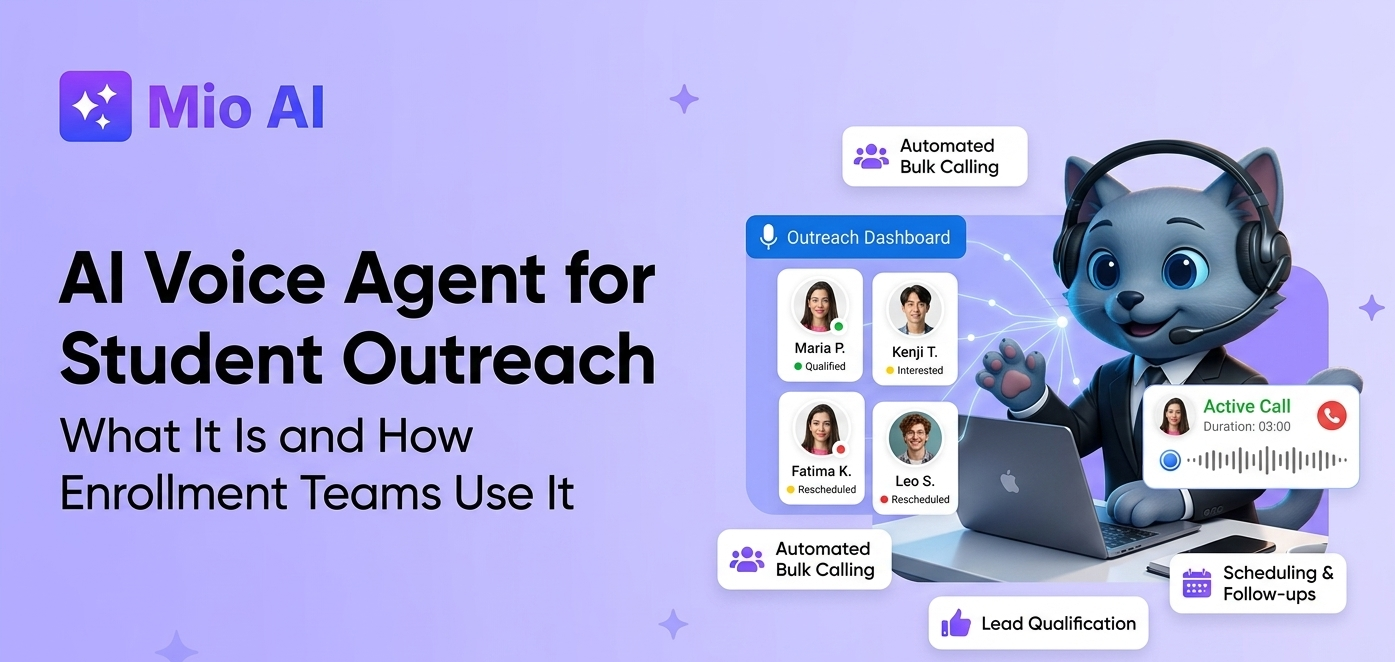
Most enrollment teams are understaffed relative to the volume of leads they manage. Calls go unreturned. Follow-ups are delayed. Students who enquired in good faith end up choosing a competitor simply because no one called in time. An AI voice agent for student enrollment changes that equation. It calls, qualifies, and re-engages students around the clock, without adding headcount.
This post explains what an AI voice agent does in a real enrollment workflow, how it differs from older call technologies, and what to look for when evaluating one for your institution.
What is an AI voice agent for student outreach?
An AI voice agent is a software system that conducts real, two-way phone conversations with students. It does not play a recorded message. Instead, it listens, understands, and responds using natural language processing trained on education-specific conversations.
In practice, the agent calls a student, identifies itself, and asks relevant questions. The student responds naturally. The agent processes each answer, follows up with context, and ends the call with a clear next step. All of this happens without a human counsellor on the line.
For enrollment teams, this means every lead receives a timely call. Response rates improve because students are reached at the right moment, not days after they enquired. Beyond that, the agent reads your CRM data before every call, so each conversation reflects what you already know about that student.
How it is different from IVR and robocalling
IVR systems route callers through a menu of options. They do not have conversations. They do not understand what the student is saying. As a result, students hang up frustrated, and your team receives no useful data from the interaction.
Robocalling is even simpler. A recorded message plays and the student listens or does not. There is no two-way exchange, no qualification, and no CRM update afterward.
An AI voice agent works differently. It processes what the student actually says and adapts its response to the context. For example, if a student says they are still deciding between two programmes, the agent adjusts and provides relevant information rather than repeating a fixed script. In addition, every interaction syncs back to your education CRM automatically, so your team always knows what was said and what comes next.
Four enrollment use cases where AI voice works best
AI voice agents perform consistently across several enrollment scenarios. Each use case below represents a workflow where manual follow-up breaks down at scale.
Lead qualification is the most common starting point. When a new enquiry arrives, the agent calls within minutes. It asks about programme interest, timeline, and decision stage. Based on the responses, it scores the lead and routes it to the right counsellor. Your team spends time only on leads ready to move forward.
Cold lead reactivation is where AI voice has the most visible impact. Students who filled out a form weeks or months ago and then went quiet receive a call with full context from their original enquiry. The conversation references their initial interest and asks what has changed. This is not a generic follow-up. It is contextual outreach that brings a meaningful percentage of dormant leads back into the funnel.
Fee and deadline reminders run automatically. When a payment deadline or document submission date approaches, the agent calls each relevant student and confirms whether they are on track. If a student signals a problem, the agent logs it and triggers a counsellor follow-up. Your team no longer needs to manually track and call hundreds of students around key dates.
Missed call callbacks are another high-value use case. When a student calls your institution and no one picks up, the agent calls back automatically. It handles the enquiry or escalates to a human if needed. Students do not have to call repeatedly, and your team does not lose leads to unanswered calls.
What happens after the call
The post-call workflow is where CRM-integrated AI voice separates itself from standalone tools. After every call, the agent generates a summary of the conversation. It updates the lead stage and disposition in the CRM for sales counselling teams and triggers the appropriate next action, whether that is a counsellor call, an email follow-up, or a reminder task. The call recording and full transcript are stored and linked to the student’s record.
This means your enrollment team starts each day knowing exactly which students were called, what was said, and what needs to happen next. There is no manual logging and no data entry. The pipeline updates itself.
For institutions also using a chat-based AI chatbot for education, the voice and chat data sit in the same CRM record. Counsellors get a complete view of every interaction, whether it happened via chat, voice, or email. This continuity prevents repeated questioning and creates a better experience for the student.
What to look for when evaluating an AI voice agent for enrollment
Not every AI voice tool is built for enrollment. Generic tools may handle simple queries but struggle with education-specific language, regional accents, and the multi-step conversations that admissions calls require. When evaluating options, focus on the following criteria.
Education-domain training matters significantly. A tool trained on general call centre data will mishandle programme-specific questions, fee structure queries, and eligibility discussions. Look for a solution trained specifically on education enrollment conversations.
Native CRM integration determines whether the tool creates value or creates more work. A tool that does not write back to your CRM forces manual data entry after every call. Verify that it reads from and writes to your CRM without requiring a custom development project.
Escalation logic is critical for student experience. The agent must recognise when a conversation requires a human and hand off cleanly, with full context passed to the counsellor. A tool that gets stuck or drops the call at a complex question will damage the relationship rather than support it.
Multilingual capability is a practical requirement for most Indian institutions. Students enquire in regional languages. Understanding how what is agentic AI in education shapes voice agent behaviour is also useful context. Ask vendors whether their agent simply executes scripts or perceives student context and adapts accordingly. That distinction determines how the tool handles unexpected answers.
How Mio AI Voice works end to end
Mio AI Voice works with the enrollment context in Meritto to run AI-led voice engagement across defined student journeys. Before every call, it reads the full CRM record, including lead source, programme interest, previous interactions, and current stage. The conversation reflects this data from the first word.
After the call, Mio AI Voice updates the lead stage automatically, generates a structured summary, stores the transcript, and triggers the next workflow action. Your counsellors receive a clear queue of leads ranked by intent and readiness. There is no manual work required between the call and the follow-up.
Mio AI Voice supports multiple Indian languages and regional accents. It handles lead qualification, cold reactivation, fee reminders, and missed call callbacks within a single platform. Because it operates on the same system as the broader AI enrollment platform, voice and chat interactions share the same data layer. Your team sees a complete student history in one place, with no switching between tools.
Want to see how Mio AI Voice works in practice? Schedule a demo at getmio.ai and see it in action inside your enrollment workflow.