
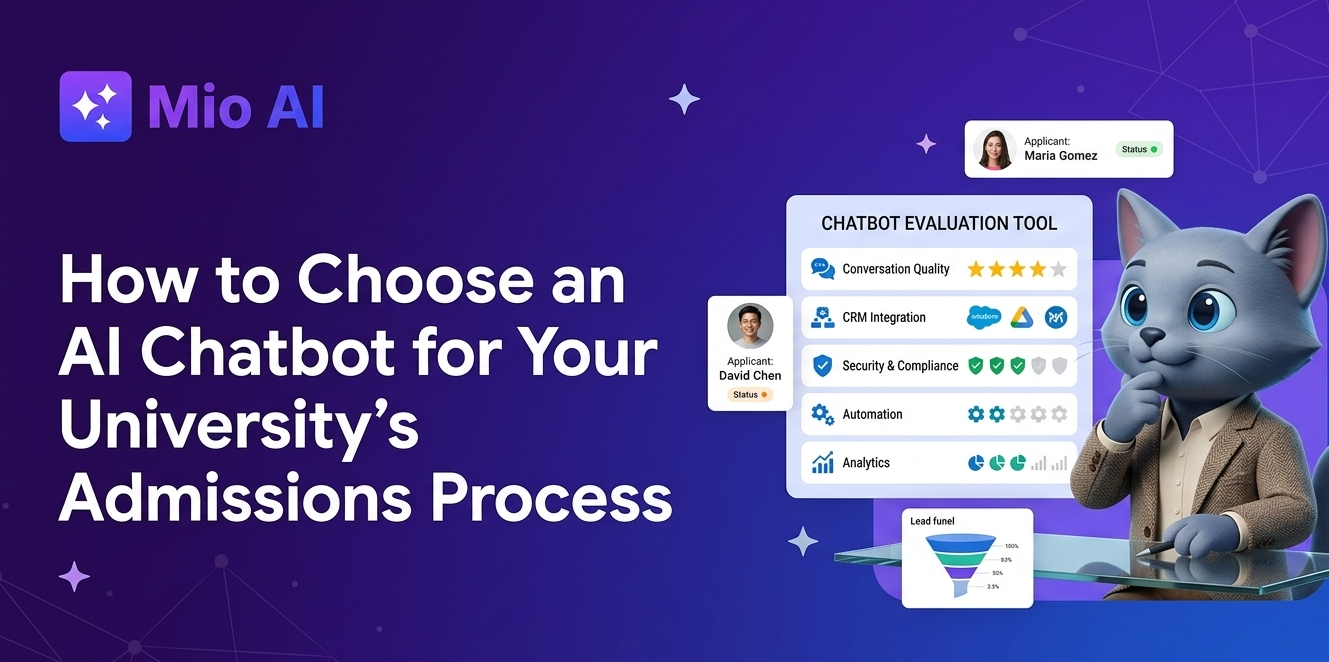
Choosing an AI chatbot for university admissions is not a simple software purchase. The tool you deploy sits at the front of your enrollment funnel. Before your counsellors speak to a single student, this chatbot already has. It qualifies leads, answers questions at midnight, and either builds or breaks a student’s first impression of your institution.
Get it right and your team focuses on high-intent conversations. Get it wrong and you have an expensive, underperforming bot that frustrates students and clogs your pipeline with unqualified leads.
This guide gives you a practical framework for making the right call.
What does an AI chatbot actually do in the admissions process?
An AI chatbot for university admissions handles the volume of student queries that no human team can manage at scale. It sits on your website, admission portal, and sometimes your WhatsApp channel. In practice, it responds instantly, around the clock, without a queue.
A well-built admissions chatbot does four things. It answers queries about courses, fees, eligibility, and deadlines. It also qualifies incoming leads by asking structured questions and capturing responses. Beyond that, it routes high-intent students to counsellors at the right moment and syncs everything back to your education CRM so no lead sits without context.
This is different from a basic website widget that answers three questions and then shows a contact form. A real AI chatbot understands intent, adapts its responses, and keeps the conversation going until the student either converts or disengages.
Why most institutions get chatbot deployments wrong
Most universities that deploy a chatbot and see poor results made the same mistakes. They chose a generic tool not built for education. In other cases, they deployed it without connecting it to their CRM. Or they set it up in an afternoon and expected it to perform without any training on their programs, policies, or admission processes.
The result is a chatbot that gives wrong answers, frustrates students, and eventually gets switched off. The team concludes that chatbots do not work. In reality, the wrong chatbot did not work.
An AI chatbot for admissions needs to be trained on your institution’s specific knowledge base. It must understand your programs, intake cycles, fee structures, and escalation rules. As a result, a generic tool simply cannot do that out of the box.
Beyond that, deployment without CRM integration means the chatbot becomes a dead end. It answers queries but captures nothing useful. Your counsellors have no record of what a student asked, what they said, or how ready they are to enroll.
Five criteria to evaluate before you choose
Before you shortlist any tool, run every option through these five criteria.
Education-specific training. A general-purpose chatbot is not built to handle the complexity of admissions. For this reason, you need a tool trained on education workflows. Look for vendors who understand admission cycles, student personas, and the difference between a top-of-funnel inquiry and a conversion-ready applicant. When evaluating any AI education chatbot, ask how it handles course-specific queries and multi-program institutions.
Native CRM integration. The chatbot must read from and write to your CRM in real time. Not a weekly export. Every conversation should update the lead record automatically: stage, intent signals, queries raised, and next action. Without this, the chatbot creates more work for your team rather than less.
Multilingual support. If your institution draws students from multiple states or countries, your chatbot must support regional languages natively. This means genuine NLP-based understanding, not word-for-word translation. In practice, a student asking in Hindi or Tamil should get the same quality of response as one asking in English.
Setup and go-live timeline. Ask every vendor how long implementation actually takes. A tool that requires six months of developer work is not practical for an admissions team with a cycle starting in eight weeks. The best tools go live in days once your knowledge base is ready.
Escalation to a human. No chatbot should be the last line of support. The tool must detect when a student is frustrated, confused, or ready to convert, and hand the conversation to a counsellor with full context. Escalation without context is not escalation. It is simply a transfer that wastes everyone’s time.
Questions to ask any AI chatbot vendor
When you get to the vendor conversation, go beyond the demo. Ask these questions directly.
How does your chatbot handle a query it cannot answer? You want to hear: it escalates to a human with the full conversation thread. Not: it says “please call us.”
How does CRM integration work, and who owns the setup? Some vendors claim CRM integration but deliver a basic webhook. As a result, you need to understand who configures it, how long it takes, and what happens when your CRM changes.
What does your training process look like for a new institution? Good vendors have a clear onboarding process. They ask for your knowledge base, your FAQs, and your program details. Then they work with you to configure the chatbot before go-live.
What admission management software have you integrated with before? Vendors who have worked within real admissions environments understand the edge cases that generic SaaS providers often miss.
Can you show me a live deployment at a similar institution? References from universities or EdTech companies like yours matter more than case study PDFs.
How Mio AI Chatbot meets each criterion
Mio AI Chatbot is natively integrated with Meritto, using enrollment context to power relevant student conversations, used by over 1,000 educational institutions. This means it is not a generic chatbot adapted for education. Instead, it is designed from the ground up for the admission and enrollment workflow.
On education-specific training, Mio AI Chatbot trains on your institution’s knowledge base before go-live. It understands your programs, your intake cycle, your fee structure, and your escalation rules. As a result, students get accurate, context-aware answers rather than generic responses.
On CRM integration, Mio AI Chatbot reads and updates Meritto platform in real time. Every conversation updates the lead record automatically. Your counsellors, therefore, see what a student asked and how they responded before they pick up the phone.
On multilingual support, Mio AI Chatbot handles regional Indian languages natively. This matters particularly for institutions drawing students from across states with different language preferences.
On setup timeline, most institutions go live within days. The knowledge base configuration is the main variable, and Mio AI’s team supports the onboarding process end to end.
On escalation, Mio AI Chatbot detects intent signals and hands off to a counsellor with the full conversation context. The counsellor does not start from zero. They start informed.
For institutions evaluating an AI chatbot for university admissions, Mio AI Chatbot is worth a direct look. It also operates as part of a broader AI agents for student enrollment platform, meaning it works alongside voice agents and CRM automation rather than as a standalone tool.
Making the final call
The right AI chatbot for university admissions is not the cheapest or the most feature-rich. It is the one that fits your enrollment workflow, integrates with your CRM, and trains on your institution’s specific context.
Start with your own requirements. Map your top five query categories, understand your peak inquiry periods, and know your languages. Then evaluate tools against the five criteria above rather than against a vendor’s marketing slides.
In practice, the institutions that get the most from AI chatbots treat them as a core part of the enrollment workflow, not an add-on. They train them properly, integrate them fully, and review performance every month. That approach is what separates a chatbot that converts from one that collects dust.