
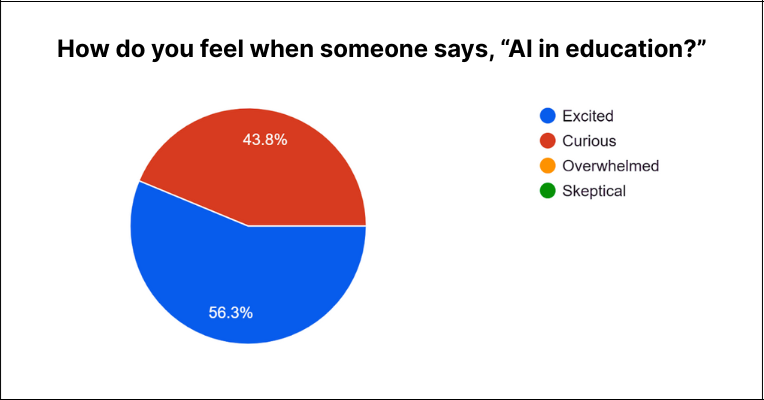
A recent survey asked education leaders how they feel about AI agents in education and the results were telling: 56.3% feel excited, and 43.8% feel curious. Not a single respondent expressed fear or resistance.
This is no longer a distant concept sitting on the fringes of higher education strategy. Institutions now see AI agents in education as powerful enablers, something they are genuinely enthusiastic to explore. But what is driving this excitement, and how should institutions channel it?
Let’s take a closer look at what this sentiment reveals and where the road may lead from here.
From Conversation Starter to Strategic Priority
For years, artificial intelligence appeared in higher education panels, whitepapers, and tech showcases. Yet most institutions treated it as just that: a conversation. It generated curiosity, but not commitment.
Today, that is changing. AI is no longer just another technology layer. Institutions now consider it a direct response to some of education’s most pressing operational and engagement challenges. They are beginning to ask important, grounded questions:
- How can we offer timely responses to thousands of inquiries?
- What is the best way to support multilingual communication at scale?
- How do we ensure students stay informed, guided, and engaged without overburdening our staff?
This shift from abstract curiosity to practical use-case thinking is what makes the current moment so significant.
Why AI Resonates More Today Than Ever Before
Part of the growing enthusiasm around AI chat agents in education comes from their direct relevance. The student journey is now more complex, more digital, and more demanding. From first inquiry to final enrollment, students expect institutions to be present, responsive, and helpful at every step.
At the same time, teams inside institutions face real strain. Staff manage increasing volumes of inquiries, multiple communication channels, and rising expectations, without proportionate increases in resources. This gap between capacity and expectation is exactly where AI becomes not just helpful, but essential.
AI chatbot agents in education deliver real-time support, faster response times, and personalized interactions, all without adding pressure to existing teams. Institutions are no longer treating this as a hypothetical benefit. Many already see it in action.
Moving Beyond Automation: The Need for Intelligent Systems
Not all AI works the same way. Many institutions have experimented with rule-based chatbots or simple workflow automation. These tools have their place, but they come with real limitations. Pre-programmed rules can only handle predefined scenarios, and nuanced queries often cause them to fall short.
Such tools reduce steps, but they rarely drive outcomes.
The next wave of AI agents in education works differently, it is agentic. Agentic AI systems act with context, intent, and autonomy. Rather than waiting for inputs, they anticipate needs, adapt to behavior, and actively work toward outcomes. This is the kind of AI institutions are getting excited about, and for good reason.
Mio AI: A High-Performance, Industry-Ready Agentic AI
Built for Education, Not Adapted to It
One clear example of this shift is Mio AI – a high-performance, industry-ready AI built specifically for education. Rather than functioning as a tool that needs constant prompting, Mio AI operates as a digital teammate: integrated, intelligent, and capable of working alongside human teams to solve real enrollment and engagement challenges.
As one of the most capable AI chat agents for higher education, Mio AI supports:
- Lead capture and qualification on your website
- Real-time, multilingual support in your student portals
- Intelligent nudges and query resolution during applications
- Continuous learning through your own content (FAQs, docs, policies)
- A personalized experience aligned to your institution’s brand and tone
What makes Mio stand out is not just what it can do, but how it works autonomously, contextually, and at scale. Drop-off rates fall, response times improve, and your team gains the freedom to focus on high-value work.
Results Institutions Are Already Seeing
Institutions using Mio AI have already seen:
- Up to 70% gains in operational efficiency
- Over 60% of student queries resolved without human intervention
- Significant improvement in student experience and onboarding speed
Mio supports multiple use cases across the student journey. On institutional websites, it engages prospective students in personalized, context-aware conversations capturing leads, qualifying intent, and resolving queries in real time. Within student portals, Mio provides multilingual support, prompts next steps, reduces drop-offs, and helps students move forward with confidence.
Powered by Continuous Learning
Mio’s Core knowledge engine continuously learns from institutional content, FAQs, policies, and documents to keep responses brand-aligned and current. Teams also gain visibility into student behavior, AI performance, and areas for improvement, enabling smarter decisions over time.
Going Further: AI Voice Agents for Higher Education
Beyond chat, forward-thinking institutions are exploring AI voice agents for higher education as the next frontier of student engagement. Voice AI agents for EdTech bring the same intelligence and personalization to phone-based interactions giving institutions 24/7 AI voice agent support for admissions queries, follow-ups, and student guidance without growing staff workloads.
Phone calling AI agents for education prove especially effective at re-engaging prospective students who have gone quiet mid-funnel delivering timely, human-sounding outreach at scale.
A Shift Worth Paying Attention To
More than half of education leaders feel excited when they hear “AI in education.” That is not just a sentiment, it is a signal. Institutions stand ready to move beyond talking and start deploying AI agents in education in meaningful, student-first ways.
Agentic AI, like Mio, represents the next step forward. Rather than replacing people, it enables them to do more of what matters, removing friction, amplifying support, and helping institutions perform at a higher level without extra effort. According to UNESCO’s guidance on AI in education, student-centered AI implementation is fast becoming a global priority for institutions at every level.
Excitement is a great starting point. With chatbots and voice AI agents for EdTech like Mio, institutions now have a clear path to turn that excitement into action.