
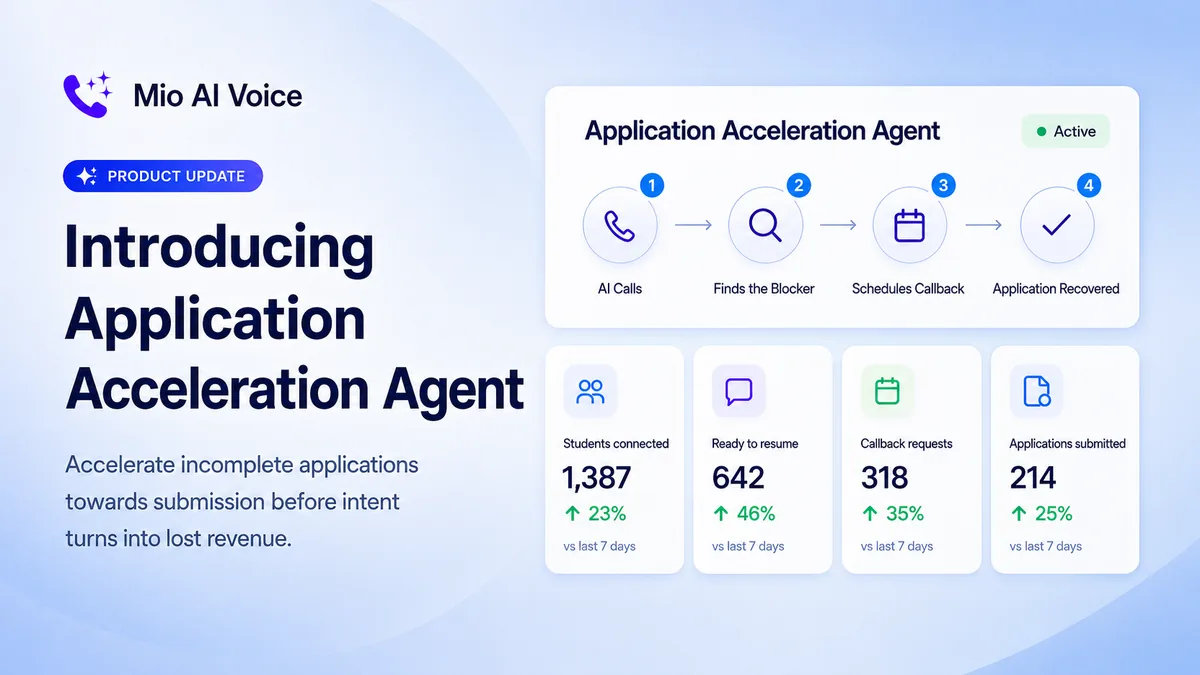
A student who starts an application has already shown intent. An AI voice agent for incomplete student applications exists because that intent often gets stuck, not lost. A confusing document upload, an unanswered question, or a missed deadline reminder can stall an otherwise interested applicant. Institutions that treat every incomplete application as a dead lead leave real enrollment on the table.
Why applications stall before they are finished
Most institutions assume incomplete applications mean lost interest. That assumption is usually wrong. In practice, students stall for specific, fixable reasons.
A student might be unsure which document format to upload. Another might be waiting on a scholarship answer before continuing. Some simply forget, especially during a busy admissions season. As a result, the application sits untouched, and no one on the counselling team knows why.
Manual follow-up cannot catch every one of these moments in time. Counsellors are already stretched across new inquiries, interviews, and deadlines. This means pending applications pile up until someone finally has time to call, often too late.
What an AI voice agent for incomplete student applications actually does
An AI voice agent for incomplete student applications closes that gap automatically. It calls students who started but did not submit, speaks with them in their preferred language, and identifies exactly what stopped them. Because it works around the clock, no applicant waits days for a follow-up call.
This is different from a generic reminder call. The agent listens for intent, not just confirms receipt. If a student is confused about a step, it clarifies. If a student needs a human, it captures the context and arranges a callback instead of leaving the conversation unresolved.
In practice, this changes the shape of the funnel. Applicants who might have quietly dropped off get a real chance to finish. Counsellors, meanwhile, stop guessing which pending applicants are worth chasing.
Inside the call: how Mio AI Voice reaches an incomplete applicant
Mio AI Voice, built on the education CRM, pulls each applicant’s status before dialling. It knows which step they reached and what is still missing. This context shapes the entire conversation from the first sentence.
The call itself stays natural. The agent asks what stopped the student, not just whether they plan to finish. Because it understands context rather than following a fixed script, it can respond to unexpected answers instead of reading out a generic reminder.
When a student needs more help than the agent can give, it does not end the call empty-handed. It records the reason, the student’s readiness to resume, and any callback request. A counsellor picks up the conversation already knowing the full picture.
What happens after the call ends
Every call produces structured outcomes, not just a completed or missed status. This includes applicant intent, the specific drop-off reason, callback requests, and readiness to resume the application. These outcomes update automatically inside the lead management system, so nothing depends on a counsellor remembering to log notes later.
For teams already using Mio AI for outbound calling, this works the same way as other outreach. To understand the full mechanics of that layer, see how an AI voice agent for student enrollment works end to end.
Because outcomes are structured, teams can filter for high-intent applicants immediately. A counsellor no longer has to work through an entire pending list to find who is actually close to submitting.
Why this matters for enrollment teams and counsellors
Pending-application lists tend to grow quietly during peak admission periods. Without a system to sort them, counsellors default to calling in order, not in priority. This wastes time on applicants who were never close to finishing.
An AI voice agent for incomplete applications changes that order. It surfaces the applicants most likely to convert with one more nudge. Beyond that, it uncovers patterns institutions rarely see manually, such as a document requirement that consistently confuses students.
This is closely related to the broader problem of application drop-off, covered in reduce student drop-off AI enrollment. The difference here is timing. This agent focuses specifically on applicants who are already stuck, not on preventing drop-off earlier in the funnel.
How Mio AI Voice turns incomplete applications into enrollments
Mio AI Voice’s Application Acceleration Agent brings this entire workflow into one place. It calls incomplete applicants automatically, speaks their language, and identifies what is holding them back. When personal help is needed, it hands off a fully documented context to a counsellor instead of a cold lead.
This approach fits naturally alongside other reactivation work already covered in AI lead reactivation for enrollment. Where that use case focuses on cold inquiries, this one focuses on applicants who are already partway through the funnel and closer to a decision.
For institutions managing a growing pending-application list, this is not a small efficiency gain. It is a way to recover enrollments that would otherwise be written off. As part of the broader AI enrollment platform, it works alongside chatbot and CRM automation to keep every stage of the funnel active.
Want to see how Mio AI Voice works in practice? Schedule a demo at getmio.ai and see it in action inside your enrollment workflow.