
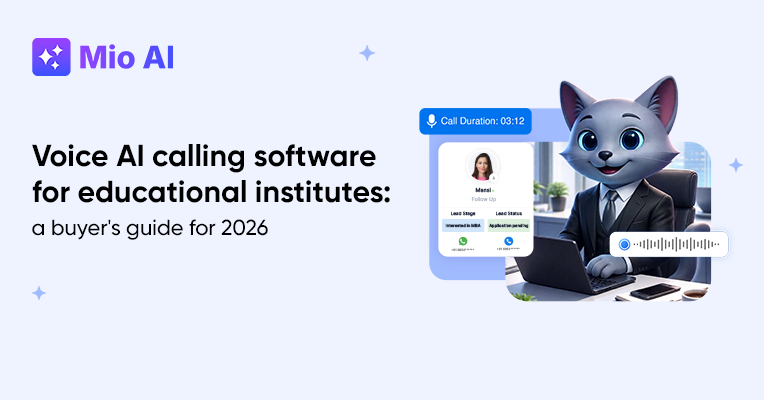
Admissions teams across universities, coaching institutes, and EdTech platforms are all dealing with the same problem. More leads to follow up, fewer counselors to do it, and students who expect a response almost instantly. Traditional outbound calling cannot keep up with this demand, and most institutes already know it.
What has changed in 2026 is that voice AI calling software has moved from being a curiosity to a genuine buying decision. Institutes are no longer asking whether this technology works. They are asking which solution is worth investing in. This guide helps you answer that question.
What voice AI calling software actually does
Before comparing options, it is worth being clear about what the technology delivers in an education context.
Voice AI calling software places and receives phone calls autonomously. It listens to what a student says, understands their intent, and responds in real time using a natural, human-like voice. Unlike a basic IVR that routes calls through a numbered menu, a voice AI agent holds a genuine back-and-forth conversation.
In practice, this means the software can qualify new inquiries, follow up with cold leads, remind students about fee deadlines and document submissions, and handle callbacks from students who missed a previous call. After each call, it automatically updates the lead status, generates a summary, and triggers the next step in the workflow without anyone on your team lifting a finger.
The real value is not just that it makes calls. It is that it removes all the manual work that surrounds every single call.
What to actually look for when evaluating a tool
Most vendor websites look the same. Everyone claims to be purpose-built, AI-powered, and easy to deploy. So rather than going by marketing language, here is what actually separates a good voice AI calling solution from a mediocre one.
Conversation quality matters more than anything else. If the AI sounds robotic, pauses awkwardly, or cannot handle a student talking over it, the experience will hurt your brand rather than help it. Look for response latency under 600ms and the ability to handle natural interruptions without breaking the flow of conversation.
Education-specific training is not optional. A generic sales bot can be configured for education, but it will take months of customization and still fall short. A tool pre-trained on enrollment journeys, program FAQs, and student decision-making patterns is ready to perform from day one.
CRM integration should be native, not bolted on. If a vendor tells you that connecting to your CRM requires custom development on your end, that is a significant red flag. Good voice AI calling software for educational institutes should sync lead data in and call outcomes out automatically, without your IT team being involved.
Post-call automation is what creates real efficiency. The call itself is only part of the job. What happens after matters just as much. Auto-generated summaries, lead stage updates, and follow-up scheduling should all happen without manual input.
Human handoff cannot be an afterthought. Students sometimes ask questions that go beyond what any AI should answer on its own. The ability to transfer a call to a live counselor with full context already carried over is not a nice-to-have. It is essential.
Voice AI calling software for educational institutes: a buyer’s guide for 2026
Admissions teams across universities, coaching institutes, and EdTech platforms are evaluating voice AI calling software more seriously than ever before. More leads to follow up, fewer counselors to do it, and students who expect a response almost instantly. Traditional outbound calling cannot keep up, and most institutes already know it.
What has changed in 2026 is that voice AI calling software has moved from being a curiosity to a genuine buying decision. Institutes are no longer asking whether this technology works. They are asking which solution is worth investing in. This guide helps you answer that question.
What voice AI calling software actually does for educational institutes
Before comparing options, it is worth being clear about what the technology delivers in an education context.
Voice AI calling software places and receives phone calls autonomously. It listens to what a student says, understands their intent, and responds in real time using a natural, human-like voice. Unlike a basic IVR that routes calls through a numbered menu, a voice AI agent holds a genuine back-and-forth conversation.
In practice, this means the software can qualify new inquiries, follow up with cold leads, remind students about fee deadlines and document submissions, and handle callbacks from students who missed a previous call. After each call, it automatically updates the lead status, generates a summary, and triggers the next step in the workflow without anyone on your team lifting a finger.
The real value is not just that it makes calls. It is that it removes all the manual work that surrounds every single call.
What to look for when evaluating voice AI calling software
Most vendor websites look the same. Everyone claims to be purpose-built, AI-powered, and easy to deploy. So rather than going by marketing language, here is what actually separates a good solution from a mediocre one.
Conversation quality matters more than anything else. If the AI sounds robotic, pauses awkwardly, or cannot handle a student talking over it, the experience will hurt your brand rather than help it. Look for response latency under 600ms and the ability to handle natural interruptions without breaking the flow of conversation.
Education-specific training is not optional. A generic sales bot can be configured for education, but it will take months of customization and still fall short. A tool pre-trained on enrollment journeys, program FAQs, and student decision-making patterns is ready to perform from day one.
CRM integration should be native, not bolted on. If a vendor tells you that connecting to your CRM requires custom development on your end, that is a significant red flag. Good voice AI calling software should sync lead data in and call outcomes out automatically, without your IT team being involved.
Post-call automation is what creates real efficiency. The call itself is only part of the job. What happens after matters just as much. Auto-generated summaries, lead stage updates, and follow-up scheduling should all happen without manual input.
Human handoff cannot be an afterthought. Students sometimes ask questions that go beyond what any AI should answer on its own. The ability to transfer a call to a live counselor with full context already carried over is not a nice-to-have. It is essential.
Deployment speed tells you a lot about the product. If a vendor quotes you a three to six month implementation timeline, question it seriously. Modern voice AI calling software should get you live in days, not months.
The red flags most educational institutes miss
Beyond the checklist, there are a few patterns worth watching for during vendor conversations.
Some tools are built for B2B sales or customer support and then positioned for education with minimal adjustment. These tend to struggle with the specific nuance of student conversations, which involve program comparisons, eligibility questions, emotional decision-making, and parents who are often part of the process.
Others offer strong outbound calling but cannot handle inbound callbacks at all. This creates a gap where a student who missed a call and calls back gets a poor experience, which can undo the goodwill the outreach was trying to build.
Finally, watch out for reporting that stops at the call level. Dial counts and call durations tell you very little on their own. What you actually need is visibility into how calls connect to lead progression and enrollment outcomes. Without that link, measuring ROI becomes guesswork.
How Mio AI voice fits the criteria
Mio AI voice from Mio AI is purpose-built for student enrollment, which means it addresses the criteria above without workarounds.
It comes pre-trained on enrollment journeys so institutes are not starting from scratch. Its response latency sits at 500ms, which keeps conversations natural. It supports multiple Indian languages and adapts to a student’s preferred language mid-conversation. Because it is natively built on top of Meritto Education CRM, lead data flows in before the call and call outcomes flow back automatically after it.
Setup involves defining the agent’s role and tone and uploading your FAQs and program details through Mio AI guide. Most institutes go live within a few days with no engineering effort required on their end. Mio AI is also SOC 2, ISO 27001, and GDPR compliant, so student data stays protected throughout.
Mio AI voice is not positioned as a replacement for your counseling team. It handles the high-frequency, repetitive calling work so your counselors can focus entirely on conversations that genuinely need a human.
The bottom line
Voice AI calling software has matured enough in 2026 that the question is no longer whether to adopt it. The question is which solution will actually deliver results in your specific context.
Use the criteria in this guide to cut through the noise. Prioritize education-specific training, native CRM integration, and end-to-end reporting over surface-level features. And always ask for a live demo with your own use case, not a scripted walkthrough.
If you want to see how Mio AI voice performs against these criteria, schedule a demo and evaluate it firsthand.