
An AI voice agent for admissions can help institutions answer a question that is often harder than generating another lead: which students already in the pipeline are interested enough to take the next step?
Every admission cycle leaves institutions with a sizeable audience already sitting in their database. Some leads are new. Some have spoken to a counselor but gone quiet. Some are actively comparing institutions. Others may have shown interest months ago without moving closer to an application.
The opportunity is not always to acquire more leads.
Sometimes, it is to find the intent hidden inside the ones you already have.
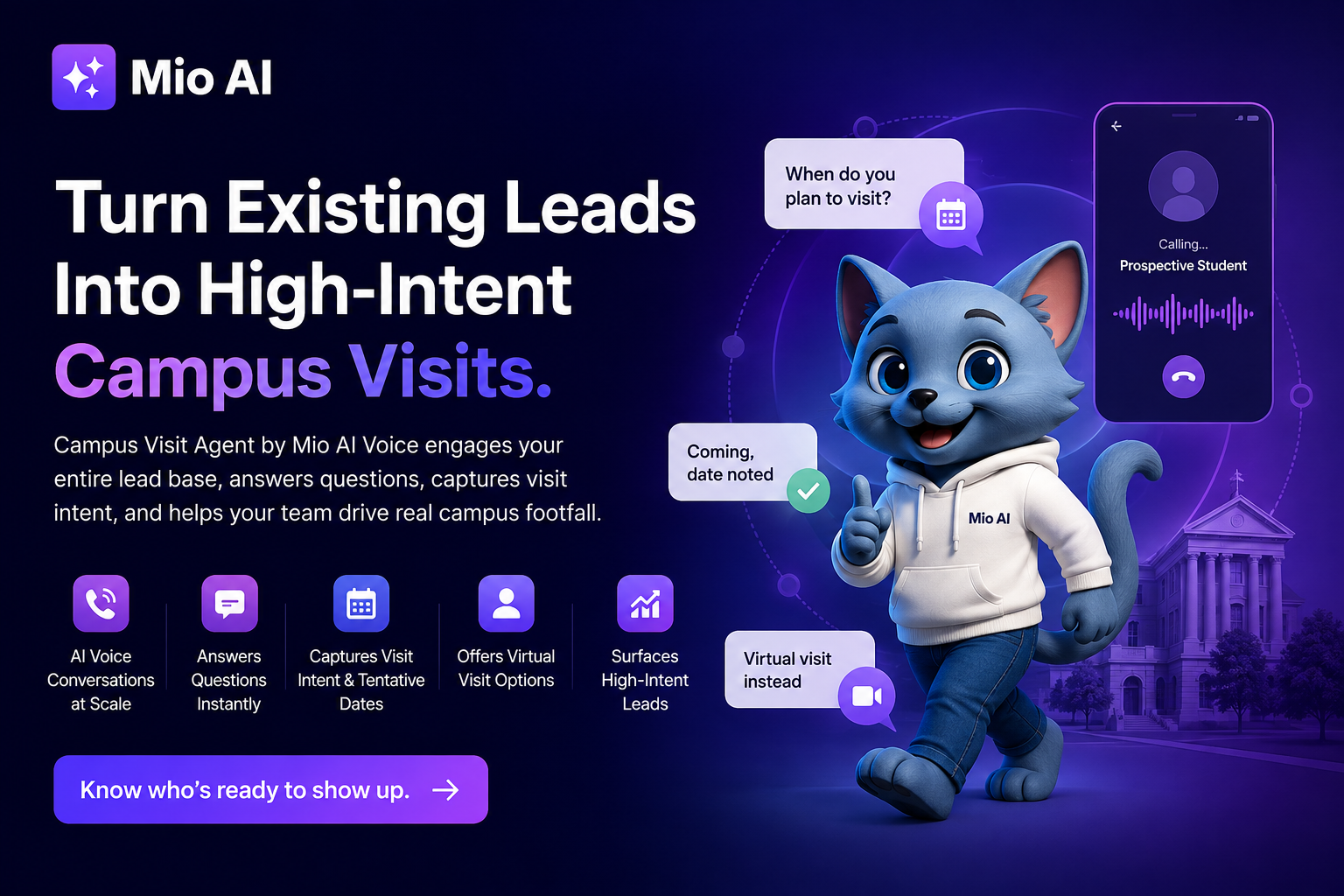
That is the idea behind Campus Visit Agent by Mio AI Voice Agent. It works across an institution’s existing lead base, starts contextual voice conversations, builds interest in visiting the campus, answers approved questions and captures who intends to come.
So instead of a database filled with leads at different levels of engagement, admission teams begin to see something far more actionable:
who may actually be ready to show up.
Why an AI Voice Agent for Admissions Can Make Campus Visits More Actionable
A digital action can happen with very little commitment.
A prospect can click an ad in seconds. Download a brochure while researching five institutions. Submit an inquiry and move on to something else immediately afterwards.
A campus visit asks for more.
The prospective student — and often their family — needs to make time, plan the journey and physically experience the institution.
That makes campus visits particularly valuable as signals of admission intent.
MARKETview found that among its partners, admitted students who had visited campus recorded an average yield rate of 37.4%, compared with an overall partner yield rate of 16.2% for the Entering Class of 2024. The figures are specific to MARKETview’s dataset, but the gap reinforces the relationship between a campus visit and stronger enrollment intent.
The problem is that students do not always independently decide to make that visit.
Sometimes, they need a reason.
Sometimes, they need a question answered first.
And sometimes, they simply need someone to start the conversation.
Your Next High-Intent Admission Lead May Already Be in Your Database
Consider what an institution’s lead base looks like in the middle of an admission cycle.
There are fresh inquiries waiting for their first meaningful conversation.
There are prospects who opened messages and explored programs but never applied.
There are students who once responded actively but have since gone quiet.
There are old leads that no longer receive counselor attention because newer inquiries have taken priority.
And there are active prospects who may be much closer to a decision than their current lead stage suggests.
This is why simply categorising a lead as “active”, “cold” or “unqualified” does not always reveal the full opportunity.
A dormant lead may still have intent.
A new inquiry may already be ready to visit.
An active prospect may simply need to understand what they will gain by coming to campus.
The challenge is having enough conversations to find out.
Mio AI has explored the same challenge in the context of AI lead reactivation for enrollment: leads can go cold not necessarily because their interest has disappeared, but because there is not enough capacity to keep reaching every prospect meaningfully.
Campus Visit Agent gives that outreach a specific objective.
Existing leads → Mio AI Voice conversation → Visit intent captured → Campus visit → High-intent admission opportunity
Instead of waiting for another form submission or another inbound interaction, the institution can proactively discover who is interested in taking a more meaningful next step.
How an AI Voice Agent for Admissions Turns Interest Into Visit Intent
Campus Visit Agent is not simply an automated announcement for an open house.
The purpose of the conversation is to understand intent and leave the admission team with an outcome it can act on.
1. It starts with an invitation, not a sales pitch
The conversation begins by introducing the institution and the campus visit or admission drive, then asking whether the student has a few minutes to talk.
That small difference matters.
The student is not immediately pushed towards a registration.
There is first a conversation around the opportunity to visit.
The institution gets the chance to explain the value of the visit before asking the prospect to commit to it.
2. It answers questions while the student is still interested
A student may like the idea of visiting but still have practical questions:
Can my parents come with me?
Which documents should I bring?
Where exactly is the campus?
Will someone be available to discuss the program?
What are the timings?
Can I discuss fees or scholarships when I visit?
Campus Visit Agent can answer approved questions during the voice conversation itself.
That means the prospect does not have to end the call, search the website, wait for a counselor or remember to ask later.
The question and the next step can stay inside the same interaction.
This is also what makes purpose-built AI voice agents for student outreach different from one-way automated calling: the conversation can respond to what the prospect actually says rather than simply delivering a recorded message.
3. It gives the prospect a reason to come
“Visit our campus” tells a student what to do.
It does not necessarily tell them why.
Campus Visit Agent can build interest around what the student can experience during the visit — from seeing the campus and learning about faculty to understanding programs, student life and the guidance available during the admission drive.
The conversation therefore moves beyond:
“We have a campus visit happening.”
towards:
“Here is why spending time on campus could help you make your decision.”
That is an important distinction when the objective is actual footfall rather than simply collecting registrations.
4. It moves from “yes” to “when?”
A prospect saying they intend to visit is useful.
Knowing approximately when they intend to visit makes that response considerably more actionable.
Campus Visit Agent can share the available drive dates and timings and ask the student for an approximate day of arrival.
Now the institution does not only know:
Yes, this student is interested.
It can know:
This student is planning to come on Saturday.
That gives admission teams better visibility before the drive and creates a more concrete signal of intent.
5. It keeps interested students engaged when they cannot travel
Not every interested student can physically reach the institution.
Distance, timing, family commitments or another constraint can make a campus visit difficult even when genuine interest exists.
That does not have to end the conversation.
Campus Visit Agent can offer a virtual campus walkthrough or video interaction as the next step instead.
The important part is that “cannot visit physically” does not automatically become “lead lost.”
6. It ends with a clear outcome
Every useful admission conversation should answer one question:
What happens next?
Campus Visit Agent is designed to return a clear outcome from each conversation, giving the admission team something concrete to work with rather than another vague call disposition.
Know What Comes Back From Every Campus Visit Call
A campaign becomes far more valuable when the outcome is not simply “called” or “connected”.
With Campus Visit Agent, a conversation can return outcomes such as:
| Call outcome | What the team knows |
|---|---|
| Coming, date noted | Strong visit intent with an approximate arrival day |
| Coming, no date yet | Positive visit intent, but timing still needs confirmation |
| Virtual visit instead | Student remains interested but cannot visit physically |
| Not coming, reason logged | Clear response with context for future engagement |
This changes the value of outbound calling.
The institution is no longer measuring activity alone.
It is capturing intent.
And because Mio AI Voice is designed around enrollment conversations rather than standalone calling, what happens after the conversation matters too. Mio AI’s approach to CRM-integrated AI calling is built around turning call outcomes into information that teams can use after the interaction, instead of leaving another manual follow-up task behind.
From “Yes, I’ll Come” to Actually Showing Up
There is another problem admission teams know well:
A student saying yes does not guarantee that they will arrive.
Plans change.
People get busy.
Appointments are forgotten.
Travel becomes inconvenient.
This is why the period between expressing intent and the actual visit matters.
Evidence from other appointment-based environments shows the value of proactive reminders. A systematic review covering 29 studies found that automated reminders reduced non-attendance by approximately 29% of the baseline rate, while manual telephone reminders reduced it by around 39%. The research concerns healthcare appointments rather than campus visits, so these percentages should not be directly projected onto admissions. The useful behavioural insight is that proactive communication before a planned appointment can materially influence attendance.
For admission teams, that makes capturing an intended arrival date valuable.
Once the institution knows who plans to come and approximately when, the visit can become part of a more deliberate follow-up journey.
It is also why use cases around phone calling AI agents and no-show reduction matter beyond conventional counselor appointments.
First establish intent.
Then make that intent actionable.
Why an AI Voice Agent for Admissions Works at Scale
Campus Visit Agent becomes particularly useful when the audience is not 50 prospects, but 500, 5,000 or more.
Manual calling creates a straightforward capacity problem.
The larger the database, the more time counselors spend attempting calls, repeating basic information, handling routine questions and updating outcomes.
Meanwhile, the genuinely high-intent prospect is mixed into the same queue as everyone else.
An AI voice agent for admissions changes that operating model.
Reach more of the existing pipeline
Campus Visit Agent can work across large lead lists within a short period, giving institutions a way to activate prospects that may otherwise remain untouched.
That can include new leads, dormant leads, unqualified leads and prospects already progressing through the funnel.
Maintain consistency across conversations
The institution can define the information, conversational boundaries and approved responses that should guide the interaction.
That makes the five-hundredth conversation follow the same intended experience as the fifth.
Support multilingual student conversations
Student recruitment rarely happens in one language.
Voice AI allows institutions to extend conversational outreach across a broader prospect audience without requiring every calling queue to depend on the availability of a particular counselor.
Mio AI Voice is built specifically around multilingual enrollment conversations and contextual calling across the student journey.
Scale outreach without scaling tele-calling headcount at the same rate
The objective is not simply to make more phone calls.
It is to make more useful conversations possible without asking admission teams to increase manual calling capacity proportionally.
That is especially relevant for institutions dealing with the broader challenge of AI voice agents in higher education, where large lead volumes and limited counselor time often exist simultaneously.
The Real Value Is Not the Call. It Is the Intent Signal.
Consider two leads inside the same admission database.
Both submitted an inquiry.
Both opened messages.
Neither has applied.
From a basic funnel view, they may look similar.
Then Mio AI Voice speaks to both.
The first says:
“I’m not considering the program anymore.”
The second says:
“Yes, my parents and I are planning to visit this Saturday.”
Those two records should no longer look the same to the admission team.
One conversation has uncovered a clear difference in intent.
This is where an AI voice agent for admissions becomes more than a calling automation tool.
It becomes another mechanism for understanding where a prospective student actually stands.
The visit itself can then become an additional signal alongside the rest of the student journey.
And when teams want to go further in interpreting those signals, Mio AI Coach is designed to analyse lead journeys, interpret intent and surface recommended next actions for counselors.
The broader opportunity is straightforward:
Do not treat every lead equally when their behaviour is telling you otherwise.
From More Leads to More Value From the Leads You Already Have
Student recruitment strategies naturally focus on acquisition.
More campaigns.
More inquiries.
More channels.
More leads at the top of the funnel.
But every lead already acquired represents marketing effort that has already been spent.
If potentially interested prospects remain untouched because a team cannot reach them all, adding another thousand leads does not solve that underlying problem.
Activating the existing pipeline can therefore become just as important as growing it.
Campus Visit Agent provides one practical way to do that.
Instead of asking every old lead whether they are “still interested”, the conversation can have a tangible objective:
Would experiencing the institution in person help you take the next step?
That makes the outreach easier to understand for the student and more useful for the institution.
What Campus Visit Agent Changes for Admission Teams
The effect is less about introducing another calling channel and more about changing what the team knows before the campus visit begins.
More of the lead base gets reached.
Prospects do not have to remain untouched simply because counselor bandwidth is limited.
Visit intent becomes measurable.
Teams get another signal beyond clicks, downloads and form submissions.
Approximate arrival days become visible.
The institution can understand when interested prospects are considering visiting.
Students unable to travel do not automatically fall out of the journey.
A virtual alternative keeps the next step open.
Counselors gain a more prioritised audience.
Instead of starting with another undifferentiated contact list, teams can focus on the students whose conversations indicate stronger intent.
This is where voice AI starts to matter operationally.
Not because the AI made a call.
Because the call helped the team understand who deserves attention next.
Campus Visits Can Become a Lead-Intent Strategy
For years, campus visits have primarily been thought of as events to organise and promote.
There is another way to look at them.
They can become an intent-discovery mechanism.
If a student is willing to make time to experience the institution, meet the team and understand the environment more closely, that behaviour tells the admission team something meaningful.
Campus Visit Agent makes it possible to actively uncover that signal across a much larger audience.
That changes the question from:
“How many people registered for our campus drive?”
to:
“Which prospects in our entire pipeline are showing signs that they are ready to move closer to a decision?”
That is a considerably more valuable question.
Your Audience Is Already There. Find Out Who Is Ready to Show Up.
Institutions spend significant time and budget creating the admission pipeline.
Campus Visit Agent helps extract more value from it.
An AI voice agent for admissions can start the conversations counselors may not have the capacity to initiate at scale, answer the questions that stand between interest and action, capture who intends to visit and give teams clearer signals about where their attention may matter most.
A click indicates interest.
An inquiry gives you a lead.
A conversation gives you context.
And a prospect willing to show up can give you something more:
intent.
With Mio AI Voice Agent, that intent does not have to stay hidden inside your database.
Turn the pipeline you already have into your next campus visitors.
Explore Campus Visit Agent with Mio AI Voice →
Frequently Asked Questions
What is an AI voice agent for admissions?
An AI voice agent for admissions is a conversational AI system that can conduct voice interactions with prospective students around different stages of the enrollment journey. Unlike one-way automated calls, it can understand responses, continue a two-way conversation, capture outcomes and help determine the appropriate next step.
What is Campus Visit Agent by Mio AI Voice?
Campus Visit Agent is a Mio AI Voice use case built to engage prospective students already present in an institution’s lead base. It introduces the campus visit, answers approved questions, builds interest, captures whether the student plans to attend and records a clear outcome for the admission team.
Can Campus Visit Agent reach dormant leads?
Yes. Campus Visit Agent can be used across different lead segments, including dormant or previously unresponsive prospects, to determine whether interest still exists and whether a campus visit could become their next step.
Does Campus Visit Agent only invite students to campus?
No. The objective is not simply to announce the visit. The agent can answer relevant questions, explain what the student can expect from the visit, capture an approximate arrival day and provide a virtual alternative when physical travel is not possible.
What happens after an AI voice call?
The outcome of the conversation can provide the team with structured context such as whether the student intends to come, whether an arrival date is known, whether a virtual option is preferred or why the student is not planning to visit. This gives teams clearer information for deciding what should happen next.
Can Mio AI Voice support large admission lead databases?
Campus Visit Agent is designed for outreach at scale, allowing institutions to engage larger contact lists without increasing manual tele-calling effort at the same rate. This makes it useful when the opportunity is spread across hundreds or thousands of existing prospects.
How is campus visit intent useful for admission teams?
Visit intent creates an additional signal that can help teams understand which prospects may be moving closer to an admission decision. Rather than treating every lead in the database equally, teams can use the outcome of the conversation to prioritise subsequent engagement.